


Introduction
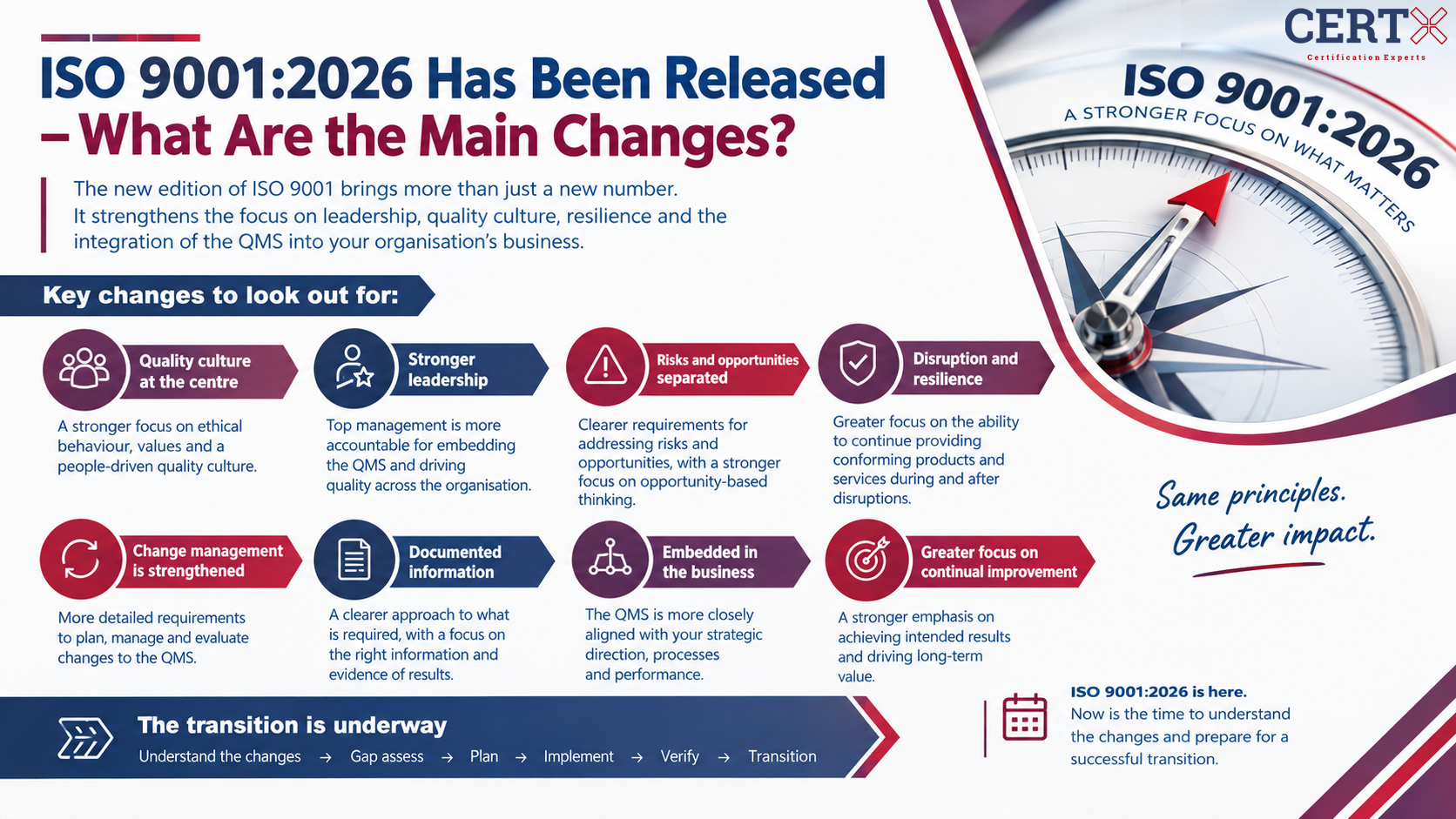
ISO 9001:2026 has been released, bringing a stronger focus on how quality is embedded into an organisation—not simply how its quality management system is documented.
The new edition places greater emphasis on leadership, organisational quality culture, ethical behaviour, risk and opportunity-based thinking, resilience, planned change and the integration of the Quality Management System (QMS) into the organisation's wider business activities.
For organisations currently certified to ISO 9001:2015, the transition is therefore about more than updating procedures or changing references from “2015” to “2026”. The emphasis is increasingly on whether the QMS is actually contributing to the organisation's performance, decision-making and long-term success.
What are the major changes in ISO 9001:2026?
1. Quality culture takes centre stage
One of the most noticeable developments is the stronger focus on organisational quality culture.
ISO 9001:2026 introduces explicit requirements around promoting quality culture and ethical behaviour. Quality culture is reflected in an organisation's shared values, attitudes, practices and actions, and can influence how people interact with one another, customers and other interested parties.
This means organisations will need to consider not only what their procedures say, but also how people actually behave when making decisions that affect quality.
A strong quality culture can support knowledge sharing, adaptability to change, customer relationships and the effective operation of the QMS.
2. Stronger leadership accountability
The revised standard increases the emphasis on the role of top management.
Leadership and commitment now include promoting:
Quality culture and ethical behaviour
The process approach
Risk-based and opportunity-based thinking
Continual improvement
Top management is also required to take accountability for the effectiveness of the QMS.
This reinforces the principle that quality management should not sit exclusively with the quality department. It is a responsibility that needs to be embedded throughout the organisation.
3. Risks and opportunities are more clearly separated
Clause 6.1 has been restructured to distinguish between actions to address risks and actions to address opportunities.
The revised approach places greater emphasis on opportunity-based thinking rather than treating risk management only as a way of preventing undesirable outcomes.
For organisations, this creates an opportunity to look more deliberately at areas such as new technologies, improved processes, partnerships, innovation and changing customer requirements.
4. Greater focus on disruption and resilience
ISO 9001:2026 also gives greater attention to an organisation's ability to continue providing conforming products and services during and after disruptions.
The objective is not necessarily to eliminate every possible impact of a disruption. Instead, organisations should understand the level and type of impact they are prepared to accept and develop an appropriately sized business continuity approach.
Customer communication has also been expanded to include information relating to contingency actions, where relevant, including disruptions affecting products or services.
5. Change management is strengthened
The requirements for planning changes to the QMS have been expanded.
When changes are required, organisations need to consider factors including:
The purpose and potential consequences of the change
The impact on the integrity of the QMS
Available resources and information
Changes to responsibilities and authorities
Communication of the change
Monitoring and evaluation of effectiveness
Review of the results
This encourages organisations to manage change systematically rather than simply implementing changes and dealing with the consequences afterwards.
6. Quality culture and ethical behaviour become part of awareness
Awareness requirements have also been expanded.
Relevant personnel are expected to be aware not only of the quality policy, quality objectives and their contribution to the QMS, but also of the organisation's quality culture and ethical behaviour.
This reinforces the connection between people, organisational culture and the effectiveness of the QMS.
7. A clearer focus on documented information
ISO 9001:2026 also changes the way documented information is addressed.
The transition material identifies specific clauses where documented information is directly required, including the QMS scope, QMS processes, quality policy, quality objectives and operational planning and control.
The focus is therefore increasingly on having the right information and evidence to demonstrate that processes are being carried out as planned and that the QMS is effective, rather than creating documentation simply for the sake of documentation.
8. The QMS should be embedded in the business
Perhaps the most important message behind these changes is that the QMS should be an integral part of the organisation's management and business activities.
The revised emphasis on leadership, quality culture, risk and opportunity, resilience and change management all points towards a QMS that supports the organisation's strategic direction and operational performance.
In other words, quality management should not be a separate system that exists primarily to satisfy an audit. It should form part of how the organisation is managed.
What does ISO 9001:2026 mean for ISO 9001:2015 certified organizations?
The release of the new standard does not mean that organizations should immediately rewrite their entire QMS.
A more effective approach is to first understand the changes and determine how they apply to the organization's existing management system.
A practical transition approach is:
Understand → Gap assess → Plan → Implement → Verify → TransitionThe gap assessment should consider areas such as leadership involvement, quality culture, risks and opportunities, resilience, change management, documented information and how effectively the QMS is integrated with the organization's business processes.The objective should be to identify genuine gaps and opportunities for improvement—not to create additional documentation where it does not add value.
ISO 9001:2026: A shift towards quality that delivers value
ISO 9001:2026 represents an important development in quality management.
The emphasis is moving further towards leadership, behaviour, organisational culture, resilience and business performance, while maintaining the fundamental principles of a quality management system.
For certified organisations, this is an opportunity to look beyond compliance and ask a more important question:
How effectively does our Quality Management System help our organisation achieve its objectives and consistently deliver quality?The transition to ISO 9001:2026 provides an opportunity to strengthen the connection between quality management and the way the organisation actually operates.At CertX SA, we will continue to share information on the ISO 9001:2026 transition and the requirements that organisations will need to consider as the transition arrangements develop.
At CertX SA, we will continue to share information on the ISO 9001:2026 transition and the requirements that organisations will need to consider as the transition arrangements develop.
View our services page for more information on ISO 9001 certification in South Africa